 Serbian
 Albanian
 English
 French
 German
 Russian
 Turkish

American Islamic State suspect ‘stranded on Turkey border’
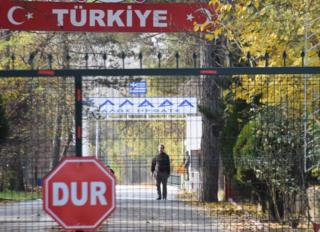
Image copyright
DHA/DHA/AFP via Getty Images
A US citizen suspected of being an Islamic State militant is stranded on the border between Greece and Turkey, after Turkey expelled him.
The alleged militant was deported on Monday as Turkey launched a drive to repatriate captured jihadist fighters held in its prisons.
Greek police said they refused him entry when he tried to cross the border near the Greek town of Kastanies.
The man is reported to have spent the night stuck between the two borders.
He has been named by Turkey’s Demiroren News Agency as Muhammed Darwis B and is said to be a US citizen of Jordanian descent.
A Turkish official told AFP news agency that he had refused to be returned to the US and instead asked to be sent to Greece.
On Tuesday he was still stuck on a strip of road between the two countries and witnesses said he had been trying to shout to reporters on the Turkish side.
The fate of foreign IS fighters has been a key question since the defeat of the group in territory it controlled in Syria and Iraq.
Turkish President Recep Tayyip Erdogan has indicated that 2,500 such militants are in prison in Turkey.
According to the George Washington University Program on Extremism, 82 Americans are known to have travelled abroad to join jihadist groups since 2012. Of those, 19 have returned – 15 men and four women – and 13 have been charged.
A spokesperson from the US State Department said it was “aware of reports of the detainment of a US citizen by Turkish authorities” but had no further comment due to privacy considerations.
Unfinished business since defeat of IS
There can be few more graphic illustrations than this of the unfinished business left over from the US-led Coalition’s military campaign to defeat IS.
More than 70 countries got together to defeat and dismantle the jihadist caliphate that had terrorised huge swathes of Iraq and Syria. But as with other military campaigns in the Middle East, they failed to plan sufficiently for the aftermath.
Following the final battle against IS at Baghuz in Syria in March, thousands of IS fighters and their dependants were interned in camps. Turkey, which has been arresting IS members for years, now has around 2,000 of them in its prisons.
Turkey, Iraq and the Kurdish authorities all want Europe and the West to hurry up and take back their citizens but so far governments have been extremely reluctant to do so, partly for fear that prosecutions may fail.
Turkey’s current expulsions now threaten to force them into action.
Who else has Turkey deported?
Turkey’s interior ministry said it had also deported a Dane alleged to be an IS member on Monday. Danish authorities said their citizen had been arrested on arrival in Copenhagen.
Germany said one of its citizens had also been expelled.
Turkey said more than 20 other European suspects, including 11 French citizens, two Irish nationals and several more Germans, are in the process of being repatriated to their countries of origin.
- The IS prisoners no-one wants
- Who is taking back foreigners who joined IS?
- Europe faces ticking time bomb in IS prison camps
Turkey has not confirmed whether those being repatriated were seized in Syria, or in Turkish territory.
Some IS members and their relatives were captured in north-eastern Syria in October, when Turkey launched a cross-border operation against the Kurdish-led Syrian Democratic Forces (SDF) there.
At the time, the SDF said it was holding more than 12,000 suspected IS members in seven prisons in the area, at least 4,000 of them foreign nationals.
Relatives of suspected IS militants were also being held at a number of camps for displaced people – the largest of which, al-Hol, housed almost 70,000 people.
Why is Turkey deporting people?
Turkey has long accused Western countries of refusing to take responsibility for citizens who joined Islamic State.
Germany, Denmark and the UK have repeatedly stripped people of citizenship for allegedly joining jihadist groups abroad, in a bid to block their return.
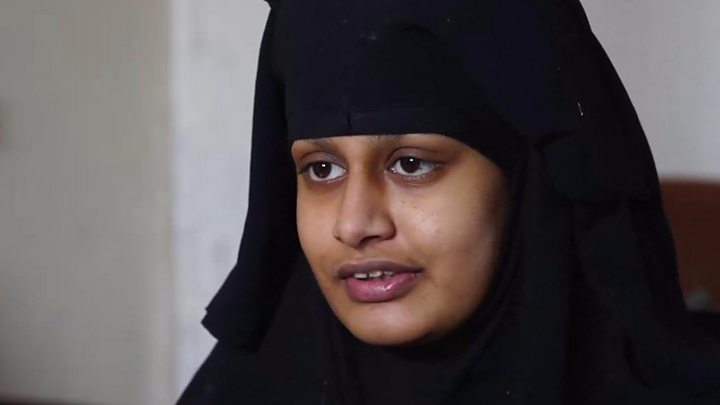
The UK is said to have withdrawn citizenship from more than 100 people – among them the IS recruit Shamima Begum, who left London as a teenager.
Media playback is unsupported on your device
On 6 October, the White House released a statement following its withdrawal from Syria saying it had urged “France, Germany, and other European nations, from which many captured ISIS fighters came, to take them back, but they did not want them and refused”.
The White House said Turkey would now be responsible for all ISIS fighters captured in the area.
On Tuesday UN chief Antonio Guterres called for international co-operation to resolve issues around foreign jihadists, saying it was not up to Syria and Iraq “to solve the problem for everyone”.
How will the repatriations work?
A French foreign ministry source told AFP news agency last week that suspected jihadists were often returned to France from Turkey under a 2014 agreement.
“Jihadists and their families are regularly sent back to France and arrested as they leave the plane. Most of the time it is done secretly. The news is not published, or released much later,” the source said.
Image copyright
AFP/Getty images
Germany’s interior ministry said this week that “it did not wish to oppose the return of German citizens”.
A German foreign ministry official confirmed that legal proceedings involving at least three men, five women and two children were under way in Turkey.
On Monday a court in the Netherlands ruled that the country should take back the children of Dutch women who joined IS – but not necessarily their mothers.
Some 23 Dutch women and their 56 children are currently being held in detention camps in Syria, AFP reports.
It is unclear whether Turkey will be able to repatriate IS suspects who have had their home citizenships revoked.
0 comments