 Serbian
 Albanian
 English
 French
 German
 Russian
 Turkish
Philippine drug war: Do we know how many have died?
By Howard Johnson and Christopher Giles
BBC Philippines Correspondent and Reality Check
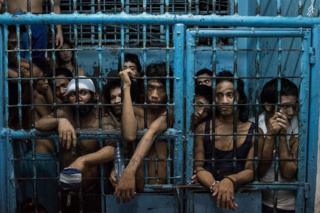
Image copyright
Getty Images
The new head of the anti-drugs campaign in the Philippines, Leni Robredo, has said the “killing of the innocent” must come to an end, referring to a government policy human rights groups have blamed for thousands of state-sponsored killings.
She is a leading opposition figure and vocal critic of President Rodrigo Duterte but she is also the country’s vice-president – a directly elected position in the Philippines.
GETTY
If this is a chance for the killing of the innocent to stop and to hold the perpetrators responsible, I will take this on.
Mr Duterte has been facing growing criticism of his controversial crackdown on illegal drug sales and use and has appointed Ms Robredo after she angered him by saying his drug policy “obviously wasn’t working”.
What has President Duterte said?
After his election in 2016, the president launched a hard-line campaign against “illegal drug personalities”, claiming the Philippines had become a “narco-state”.
The president’s spokesman, Salvador Panelo, told BBC News: “The government does not want to kill – it is not the intention.”
However, the president himself has said he would personally take the lives of millions of drug users and there have been reports local police forces have been given targets to meet in terms of the number of deaths.
Human rights groups such as Amnesty International have called the policy a “large-scale murdering enterprise” and say the police and vigilantes are proactively targeting suspected drug users.
Image copyright
Getty Images
How many have died?
There has been a great deal of debate about the death toll, with competing claims made by police officials, the government and human rights groups.
Separate investigations are currently being carried out by the United Nations and the International Criminal Court (ICC).
The UN is looking into the issue of extrajudicial killings and the ICC is conducting preliminary investigations into the president for alleged crimes against humanity.
Officially, the police say they kill only in self-defence – for example, during drug-bust operations.
In 2017, the government launched a campaign to reveal what it said were the true numbers of deaths, under the banner #RealNumbersPH.
Its latest figure, published in June 2019, was 5,526 deaths of “drug personalities”.
However, the former police chief, in the same month, publicly put the number of deaths at 6,700.
When pressed on the discrepancy between the two numbers, the president’s spokesman said it could have been an “unintentional mistake”.
These numbers, however, don’t include the drug-related killings allegedly being carried out by vigilantes inspired by the president’s anti-drug rhetoric.
In December 2018, the country’s Commission on Human Rights (CHR) estimated the number of drug-war killings could be as high as 27,000.
Image copyright
Getty Images
There is further confusion around another death toll, known as “deaths under investigation” (DUI).
In March 2019, the police told local media this figure was over 29,000 – and this has been included in the government’s official reports on the “war on drugs”.
So can these be classified as drug-related killings?
Rappler, a local media outlet, says the DUI figure is the police’s “way of categorising deaths in the war on drugs that police officials could not explain because they were outside ‘legitimate police operations'”.
And Karen Gomez, of the Commission on Human Rights, told BBC News, in August 2019, the growing number had become a “cause of serious concern” and regional police stations were blocking or delaying the release of information.
Mr Duterte has encouraged Filipinos to go and kill drug addicts and reports of vigilante groups killing suspected drug users have been well documented.
In 2018, the president told an audience the “only sin” he had committed in his time in office was the “extrajudicial killings”.
Human-rights groups say the police have targeted mostly poor communities, putting suspects on “drug lists” compiled by local community leaders.
Michelle Bachelet, the UN chief tasked with delivering the official report into allegations of human-rights abuses in the Philippines, has said even the government’s official death toll would be “a matter of most serious concern for any country”.
Promising to take a health-based approach, Ms Robredo says: “We will change the metrics, not on the number of deaths but by those number of lives being changed for the better.”
0 comments