 Serbian
 Albanian
 English
 French
 German
 Russian
 Turkish


Pascal Siakam: Toronto Raptors star & his unconventional path from Cameroon to NBA

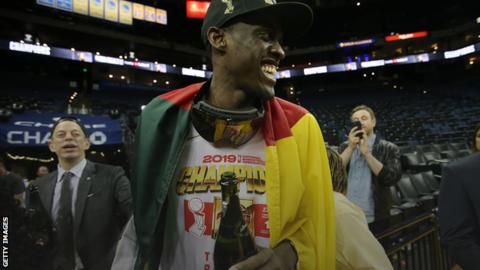
For the first 17 years of his life, Pascal Siakam didn’t pick up a basketball much. It was just a game his older brothers played.
Even though his father dreamed about one of his children growing up to play in the NBA, Siakam, the youngest of six siblings, was always more interested in other sports.
“I played soccer. I was good. I could have played soccer if I wanted,” he says.
The thing is, when you grow to be 6ft 7in tall, basketball is tough to ignore.
Considering Siakam has been playing the sport for under 10 years, his resume is more than impressive. Now 25, last season he was crowned the NBA’s most improved player. He was a major contributor as the Toronto Raptors won their first NBA championship title.
The path that led him there is not what you would call conventional.
Born in Douala, Cameroon’s economic capital, Siakam spent much of his youth at St Andrews Seminary, training for the priesthood in a small town called Bafia.
Eight hours’ drive from home, and with the discipline of the Catholic Church a strong presence in his world, Siakam didn’t always get to enjoy the vibrant lights of city life. But the experience strongly shaped him – and who he would become.
“It was really strict,” he says. “When I went there, I didn’t really know how to do a lot of things. It really taught me how to be a man. How to take responsibility and take care of myself.
“Going out there in the world by myself, finding a way and fighting on my own. I learned those values there.”
For much of Siakam’s seven years at St Andrews, basketball wasn’t even a consideration. There were daily 5am wake-up calls, with a demanding schedule of chores and tasks to occupy time around studies.
His family thought the priesthood was something he might choose to pursue as a vocation. Again Siakam thought differently.
“Obviously you’re around church and that’s what you do every day,” he says. “My dad at some point thought it could be something I wanted to do but it was never my calling.”
It turns out his calling would come from the sport he had spent much of his life trying to avoid.
In 2011, Siakam went along with friends to a basketball camp organised by Cameroonian NBA star Luc Mbah a Moute. Now a veteran of the league for 10 seasons, Mbah a Moute, 33, still runs annual basketball camps in his homeland. They also helped another player from the country make it in the NBA – Joel Embiid, the 25-year-old Philadelphia 76ers centre.
Despite never having played organised basketball before, aged 17 Siakam’s competitiveness and athleticism were impossible to ignore and a year later he was invited to attend the NBA’s international development program, Basketball without Borders (BWB), in South Africa.
“It was a big thing for me,” Siakam says. “Not because I had a great basketball experience there but the environment around it. The NBA, the coaches. It opened my eyes to a different world that I didn’t really know about.
“It got me excited and I felt like, if I got a chance to go to the US and play, why not? Also, get a good education. That was the dream.”
Playing in the NBA was at this stage still never an expectation – not for Siakam nor those close to him. But he was gaining admirers.
“He was a scrawny, skinny kid,” says Masai Ujiri, Toronto Raptors president, who first met Siakam in South Africa at the BWB camp in 2012. “But you could tell his skillset. He had scoring in him. He was just very passionate about the game. You could tell it was his all. I loved that about him.”
Ujiri is one of the NBA’s most admired executives for the way he has overseen the Raptors’ recent rise to the top. Like Siakam, he was raised in Africa – in Nigeria – and for years he has looked to invest in the continent, both through the NBA and individually, with his own outreach programme, Giants of Africa.
Of course, at the time of their first meeting in 2012 Ujiri had no idea that four years later he would be drafting Siakam as a first-round pick. But he could see a special energy, a spark to his game. It has stayed with him.
“He was just so competitive and wanted to win,” Ujiri says. “You see that mind developing. For a kid to have that at a young age, it transfers. When Pascal plays now, you see winning.”
Siakam says: “I wasn’t the greatest player but I was relentless, having that mentality to never give up and always go hard no matter what.
“I’m an athlete. Anything that involves running or jumping I’ve always been excited about, so basketball was exciting.”
By 2012, Siakam’s three older brothers had each gained scholarships in the United States. The younger Siakam would soon follow suit. His energy and enthusiasm at BWB had piqued the interest of scouts from the US. He was offered the chance to move to Lewisville to finish high school. Now aged 18, he would be leaving a whole life behind.
“Moving from Cameroon to Texas, that was a change. Learning English, the culture, everything was different so I had to adjust,” he says.
“But I’ve always been able to change scenery. From a young age, I was taught how to do that and I kind of do it naturally.”
After graduating from high school, Siakam gained a scholarship with New Mexico State University. While he was there, in October 2014, tragedy struck. His father Tchamo was killed in a car accident back home in Cameroon. Everything Siakam has done on a basketball court since is an energetic tribute to his dad.
“My dad worked hard to take care of six kids,” Siakam says. “He worked hard to make sure we had everything we needed. He had his dream and I’m able to fulfil that. I’m proud that I’m able to do that now. I just wish he was here to see it.”
Siakam left New Mexico State after two seasons of college basketball. Despite having only played the sport seriously for four years, he departed as the Western Athletic Conference Player of the Year.
Still, for some, he was seen as a risky pick at the draft in 2016.
“My guys are very good,” Masai Ujiri says. “One of our global scouts, Patrick Engelbrecht, he told me: ‘Keep an eye on him.’
“He took me to watch him a few times. Over the years, you keep tabs on them and you follow their improvement.”
Siakam had sufficiently improved in Ujiri’s eyes to draft him 27th in the first round. His journey with the Raptors would begin.
Jama Mahlalela is the head coach of the Raptors developmental side. He coached Siakam during his first season in the NBA where he flipped between the G-league squad and the main team. For him, Siakam’s energy and enthusiasm were clear from the beginning.
“We talk a lot about ‘positionless’ basketball players,” Mahlalela says. “Players who aren’t just one specific thing. Pascal is that. He can play point guard through to centre. That’s an incredible skillset to bring to the table.
“He drives himself, day-in-day-out. He doesn’t accept where he is today, he’s always striving for what player he can be tomorrow.”
This season is Siakam’s fourth with Canadian side Toronto. He went into the year with added expectation. They say in the NBA you need a superstar to win. Last season’s title success proved that.
After years of play-off failure, Ujiri and the Raptors swung for the fences and traded away arguably the franchise’s most decorated player DeMar DeRozan for a disgruntled superstar Kawhi Leonard. The risk paid off and the Raptors were at times seemingly willed to success by Leonard’s brilliance alone. His summer departure to the Los Angeles Clippers left them devoid of a superstar.
It’s a void the Raptors are confident Siakam can fill. Fresh from awarding him a new max contract that will pay him a reported $130m (GBP99.7m) over four years, the Raptors believe the only way for Siakam is up. The transformation from reluctant baller to superstar appears to be complete.
“Being a champion, I think it brings more confidence and that’s a scary thing for the NBA. Pascal with even more confidence is trouble,” Mahlalela says.
“He’s naturally a confident player, he plays that way and I think now, having the confidence to say I won this thing already as one of the key players on a championship team, that is going to build his confidence even more.”
The championship glow still lingers. Siakam returned to Cameroon for the first time in seven years this summer when he took the NBA trophy back to the Giants of Africa basketball camp organised by Masai Ujiri.
“Being around those kids who dreamed to one day be where I am today, just bringing them a taste of the trophy, something they can touch, it was an amazing feeling,” he says.
“Growing up, I didn’t have the chance to have that around so it was a special moment for sure.”
Despite the remarkable transformation – from a kid who would wake up at 5am to complete chores in a seminary to a multi-million dollar basketball player on the verge of superstardom – Siakam remains incredibly humble.
Because the Raptors are the only team outside the United States in the NBA, there’s a feeling within the organisation that they are often overlooked. But the unlikely champions now hope to be led to further success by a guy with the most unlikely of stories. A guy who dreamed of being a footballer and might have ended up a priest.
“The type of mentality we have on the team is, there’s a lot of underdogs and guys that have always been in that position,” Siakam says.
“If you ask any champion, once they get that taste of winning, they always want it back. So for me, that’s my next focus.
“We have a completely different team, people stepping up into new roles, and it’s exciting. That is what you play for.”
0 comments