 Serbian
 Albanian
 English
 French
 German
 Russian
 Turkish


How the Irish sport of hurling came to the US
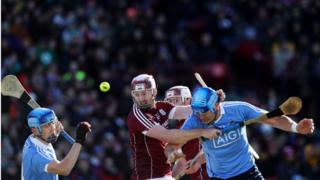
Image copyright
Getty Images
On Saturday, the annual Hurling Classic brings the Irish sport to US audiences once more, but this time in New York City. So what is this ancient sport that’s finding new popularity in America, asks Patrick Redmond?
Long ago, they say a young Irish boy found himself cornered by a ferocious guard dog.
Armed with only a ball and a bronze stick – a hurley – the boy fought back, throwing the ball down the beast’s throat before killing it with his stick.
When the dog’s master, Culann, hears what has happened, the dutiful child swears to replace the guard dog himself. And thus, with a hurley in hand, Culann’s hound, Cu Chulainn, the warrior-hero of Irish folklore was born.
Today, hurling – the field game played by Cu Chulainn – is one of Ireland’s two major national sports. Its history stretches even beyond folklore to the Tailteann Games, the “Irish Olympics,” initiated in 1600BC almost 1,000 years before the Greek version began.
It is for many the original sporting art. And sometimes, to paraphrase Ernest Hemingway, an art where the artist is in danger of death.
Hurling still epitomises the Irish warrior of old.
When the legend of Cu Chulainn was rewritten in 1894, Ireland was in the midst of a “Gaelic revival” which would lead ultimately to a violent push for independence.
The strength and fitness of Ireland’s young men was important, and the formation 10 years previously of the Gaelic Athletic Association (GAA) in 1884, which standardised the rules to the modern hurling game, would play a crucial role in Irish muscular nationalism.
The poet Brian na Banban encapsulated this in his poem The Irish Hurling men, which was even used in an advert for sportswear in 1916:
When comes the day, as come it must
That England’s rule of greed and lust
Shall lie, all broken, in the dust
We’ll still have the Irish Hurling Men.
This Saturday, the Hurling Classic – Fenway Sports Management (FSM) annual tournament to bring the sport to new audiences in the US – moves from Boston’s iconic Fenway Park to Citi Field, home of MLB’s New York Mets.
Image copyright
Getty Images
The top four counties from this year’s All-Ireland Senior Hurling competition will be participating in the Classic. In the Big Apple, FSM will be showcasing the sport to many first-time viewers, having already hosted three successful tournaments in Boston that attracted over 30,000 spectators.
“We’re aiming to replicate that success in New York and hope to introduce hurling to new audiences and generate more interest in the sport,” FSM spokesman Mark Lev told the BBC.
Reigning champions Limerick will take on Wexford, while Kilkenny and Tipperary re-enact this year’s All-Ireland final. Winners of both games will meet for the title.
What is hurling?
- Hurling is played over two halves in 70 minutes
- The field is slightly larger than a soccer pitch
- Hurling uses sticks similar to hockey, but with a larger “toe” to pick up the ball and hit it more easily
- Teams are comprised of 15 amateur players, not paid to play
- Points are scored by hitting the ball over the crossbar (1 point) or into the goal (3 points).
- Scores are counted separately with goals first, e.g. 1-3 to 0-4. The scores are then added up to decide a win, so in this example the first team wins 6-4
- The Hurling Classic will be played with teams of 11 due to smaller field sizes in the US, and points scored when the ball crosses over the bar will not be counted
Image copyright
Getty Images
For the American hurler, the game provides a level almost equal to that in Ireland. There are five senior teams in New York, and 27-year-old hurler Tommy Kavanagh says the competition “is pretty good”.
“The majority of the American-born players’ parents were born in Ireland, and their skill set would be at 17 or 18 as good as any 17 or 18-year-old in Ireland,” says Kavanagh, who hails from Borrisoleigh, near Thurles, County Tipperary.
Kavanagh came to New York three years ago and currently works in recruitment. He plays for the Tipperary club, founded in the early 1890s as the Kickhams, before changing its name in 1904 when the Irish Counties Athletics Union (ICAU), the forerunner of the NYGAA, organised New York’s GAA clubs along country lines.
“Anyone that emigrates, either to the US or the UK, that has played hurling, once they arrive in a new location, their first port of call is to join a local club, and to try and meet similar people to yourself,” Kavanagh explains.
Image copyright
Getty Images
More importantly, hurling is a key part of Kavanagh’s Irish identity and with keeping connected with Ireland: “Just because you move to a new country doesn’t mean you stop playing the game.”
Being a hurler in New York can provoke curiosity.
“Hurling is the national game of Ireland. If you carry a hurley down the street, people are very inquisitive to know what’s the game, and what is that bat. I have that sense of spreading the game.”
More on the Irish in America
- Why are US presidents so keen to be Irish?
- America’s new Irish immigrants
- Why is St Patrick’s Day so popular?
If the Hurling Classic is new to New York City, the game certainly is not. Hurling was recorded as far back as 1772, brought by Irish soldiers in the British Army. There was even an early form of “Ice Hurling” played on Collect Pond, where Chinatown is now located.
As the Irish poured into America in the wake of the famine, the sport became an important part of Irish-American life. New York’s Irish Hurling and Football Club was established in 1857, and clubs were soon set up from Boston to San Francisco.
Image copyright
Library of Congress/Bain Collection
With the opening of the Irish-American Athletic Club’s (I-AAC) Celtic Park in 1898, Gaelic sports had its first permanent home in the city.
At times hurling held a great fascination for the American sporting press. The Baltimore Sun of 12 December, 1912 described it as a sport “adapted to the impetuous temperament of the Gaels”, with players “who rush in entirely oblivious of danger”.
Image copyright
Getty Images
But by the early 1920s, following the demise of the I-AAC, Celtic Park declined into a bootlegger’s paradise.
In response the New York GAA opened its current home, Innisfail Park (now called Gaelic Park) in the Bronx in 1928, though they would often entertain Irish visitors at bigger venues such as at Yankee Stadium where 40,000 fans watched Limerick beat New York at hurling in 1936.
By the late 1960s, New York hurlers were competing with the best Ireland could provide, beating the 1969 All-Ireland champions Kilkenny in a Hurling “World Cup” final over two games.
In the past, the GAA has been criticised for putting as much effort into preventing people playing hurling – through bans on British military and police in Northern Ireland – as it does into encouraging participation.
That ban had been in place for almost 100 years but was lifted in 2002 and police officers in Northern Ireland and a British Army regiment subsequently formed GAA teams.
Recent success stories of the growth of Gaelic Football outside the Irish diaspora, like at St Paul’s Academy in South-East London, or the phenomenal growth in Galicia, Spain, have been the result of individual efforts rather than from the GAA itself.
So, who is the Hurling Classic targeted at – the Irish in America, or everyone?
Image copyright
Getty Images
Kavanagh is quick to agree that while the Irish and their descendants are key fellow participants in the US, it’s only half the story.
“On the outside of that, there’s a huge pick-up over the last couple of years collegially, with colleges all over America taking up hurling. A lot of their players would have no connection to Ireland.”
Since 2011, the US National Collegiate Gaelic Athletic Association has held a hurling championship. None of the winners – including the University of Montana with four titles – are the Catholic universities Irish-Americans have traditionally attended.
“There are a lot of things to appeal to Americans,” Kavanagh enthuses. “It’s similar to lacrosse, it is in the skill category of ice hockey, it’s high scoring like a lot of their sports.”
He understands that hurling is not an easy sport to take up, and that the small-parish feel of GAA clubs is sadly lacking in the US. But building a sense of community is why Kavanagh still thinks Americans should take an interest in hurling.
“Once you leave college here there seems so little for 27 or 28-year-olds of that small local sporting club ethos you get with hurling in Ireland. This could appeal to many of them.”
Patrick Redmond is the author of The Irish and the Making of American Sport 1835-1920 and The Irish-American Athletic Club of New York: The Rise and Fall of the Winged Fists, 1898-1917
0 comments