 Serbian
 Albanian
 English
 French
 German
 Russian
 Turkish
American Kurds take up Syria fight as Erdogan visits Trump
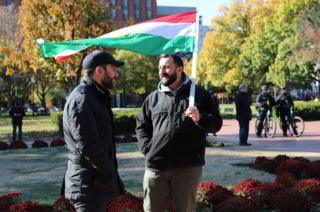
Image copyright
Deborah Bloom
The visit of Turkish President Recep Tayyip Erdogan to the White House this week reignited the controversy over his country’s actions against Syria’s Kurds. And it spurred Kurdish-American activists to take up their cause with renewed vigour, writes journalist Deborah Bloom.
A country-music loving, beer-drinking, gun enthusiast with a southern drawl, Nejeer Zebari is like any red-blooded southern American male.
But ever since US President Donald Trump abruptly pulled US troops from the Syria-Turkey border, the 44-year-old Tennessean’s focus has been 10,000km (6,200 miles) away in Kurdistan.
“We never expected this to happen after one phone call,” says Zebari, referring to Trump’s controversial October phone call with Mr Erdogan that paved the way for a Turkish military offensive against US-backed Kurdish forces. “It was a complete betrayal.”
Zebari was driving from Nashville to a demonstration in Washington to protest against Mr Erdogan’s visit to the White House earlier this week. It was a cold day and he was irritable.
“I’m sick of these protests,” he says. Three weeks ago, right after the White House announced it would withdraw troops in the region ahead of Turkey’s “long-planned operation” into northern Syria, he’d left his wife and three children in Nashville to drive north to protest outside the White House.
“But then Turkey is going to attack us, and Trump is gonna roll out the red carpet for him?” he said angrily, driving into the night.
After the announcement of Erdogan’s visit to the White House – following weeks of air strikes on Kurdish villages – Zebari was moved to act.
He’s one of several Kurdish-American activists across the US that has stepped into leadership roles meant to give a stateside voice to the Kurdish plight.
Individually, they support the Kurds in their own ways – through clothing drives, social media campaigns, phone banks, meetings with Congress, and beyond. Collectively, they hope to meet the increasingly obvious need for Kurdish support and influence in the United States.
Image copyright
Getty Images
- THE KURDS: Who are they and why don’t they have a state?
- HEAR THEIR STORIES: The world has closed its eyes on us
- TURKEY v SYRIA KURDS: The story in 100, 300 and 800 words
Though Zebari emigrated to the US when he was a young child, he’d heard about the misery of cold winters in refugee camps from friends who’d experienced them firsthand – stories of people fighting over food and clothing, their hopes dwindling of ever being resettled. His own family fled the Second Iraqi-Kurdish War to a refugee camp in Iran, where he was born.
After US troops left the Turkey-Syria border, “we knew Turkey was going to attack. We all knew there would be refugees running away with nothing,” Zebari said. “I just felt like I had to do something.”
He started a clothing drive, and enlisted the help of a handful of local Kurdish Americans to help organise it. With Nashville housing the largest population of Kurds in the United States, Zebari soon found himself flooded with contributions coming in locally. Then boxes started flooding in from all over the country.
So far they have collected more than 650 boxes of humanitarian supplies, including baby formula, winter clothes, toothbrushes, medical supplies, and blankets to ship to a refugee camp near the Iraqi border, where Syrian Kurds have been fleeing Turkish bombardment. The shipment will weigh over 18 tonnes.
Of those boxes, 247 came from Dallas, Texas, which also houses a sizable number of Kurdish Americans. That’s where Saman Gardy, 37, co-founded the Kurdish Community of Dallas-Fort Worth in the immediate aftermath of the troop pullout.
Image copyright
Getty Images
He and four other Kurdish-American community members created a Facebook page for the group, which quickly ballooned to 1,000 likes within the first week. From there, they shared a flier about Zebari’s clothing drive and began immediately accumulating donations of winter clothes and baby formula.
“We’ve got family and friends that are currently in those camps,” Gardy said. “We’re keeping in touch with them constantly.”
Gardy says he and his fellow advocates are in the midst of starting a non-profit to fundraise for non-governmental organisations on the ground in Kurdistan Region. “When I saw these children getting killed, I saw myself and my son and I thought, ‘what if that was my son in that situation?’ Especially knowing that I’ve been down that road.”
Gardy’s family fled Saddam Hussein’s brutality following the Kurdish uprising of 1991, crossing into Turkey and living in a displacement camp there for three years. At 13 years old, Gardy came to the US and joined a growing community of Kurdish refugees immigrating to the Dallas-Fort Worth area.
“Many of us are first-generation [Americans]. We barely understand the system, the way things work,” he said. “But this was a wake-up call,” he added, referring to Trump’s abrupt shift in foreign policy. “We realised we needed to be networking with other Kurds, and connecting with different Kurdish communities.”
Image copyright
Getty Images
American Kurds are a relatively new phenomenon, immigrating in waves starting in the 1970s after the First Iraqi-Kurdish War. Today, some estimates place the number of Kurds living in the United States at 40,000.
The Kurdish National Congress of North America, the nation’s oldest and largest umbrella organisation representing American Kurds, held its 30th annual conference less than a month after Turkey started its invasion of northeast Syria. The event was hosted in a small city outside of Ann Arbor, Michigan, and was sparsely attended.
On the other hand, Gardy and his crew of Kurdish-American activists saw hundreds of Kurdish-Americans turn out to demonstrate against Trump’s foreign policy moves on the same day the president was scheduled to hold a campaign rally across the road. “For the first time ever, I saw Kurds unite and become one voice,” Gardy recalled.
In southern California, where tens of thousands of American Kurds reside, Yara Kamaran and her best friend started planning protests immediately after the White House announcement. They created fliers and circulated them on social media, and days later throngs of protesters took to the streets to demonstrate in Los Angeles and San Diego.
“Stand with Kurds! Stand with Kurds!” Kamaran shouted into a bull-horn, draped in a Kurdish flag, outside the Turkish Consulate in Los Angeles. Already interested in a career in public service, Kamaran seized on the opportunity to represent the Kurdish voice, and so she booked a flight to Washington to meet lawmakers.
Image copyright
Handout
Over a few days, she met several foreign policy aids for members of the House Foreign Services Affairs Committee, urging them to fight against Trump’s betrayal of the Kurds. As a Kurdish American, “I want to know how you are going to help stop the innocent killing of civilians in Kurdistan,” she said. Today, she says she has several ongoing conversations with congressional staffers.
“I feel like I was heard” she said, responding to a question about whether her efforts had been productive. “This is a complex situation and the staffers wanted to learn more about it, so I definitely felt like I was filling in where there was a need.”
That’s where 28-year-old Diliman Abdulkhader comes in. The Washington-based consultant came to the US after his family fled the first Gulf War and spent seven years at a refugee camp in Syria.
After troops started leaving Syria, Abdulkhader immediately began executing a plan he’d had long in the making – to form the American Friends of Kurdistan, an organization that “strengths, protects, and promotes American-Kurdish relations and supports policies that advance the national security and prosperity of Americans, Kurds, and our other allies,” according to its mission statement.
“This is a critical moment for Kurds to not allow another genocide,” Abdulkhader said. “The cycle of Kurdish refugees must end.”
Image copyright
Deborah Bloom
Abdulkhader joined hundreds of protesters at the White House to demonstrate about Erdogan’s visit. Wearing a black pea coat, he looked straight into the camera to record the first ever dispatch for the new group’s Twitter page. “We urge President Trump to reconsider his decision,” he said on video. “The Kurds have been our most reliable and trustworthy ally on the ground,”
Elsewhere in the crowd, Nejeer Zebari held a large Kurdish flag over his left shoulder. After hearing of Erdogan’s imminent visit, Zebari had wanted to bus all of Nashville’s Kurdish community to protest at the White House, but logistics quickly became too complicated.
Zebari ultimately abandoned that idea in favour of starting a clothing drive, one that would bring in far more supplies than he could have ever imagined.
Still, he felt compelled to make the trip, opting to instead rent a 15-passenger van and drive to DC with a several other Kurdish-American activists.
“I couldn’t just not come,” he said.
0 comments