 Serbian
 Albanian
 English
 French
 German
 Russian
 Turkish

Polio in Nigeria: ‘I opposed vaccinations until my son caught polio’
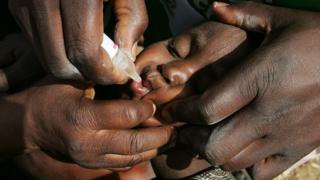
Image copyright
Getty Images
Adamu Misa used to chase health workers away from his home in northern Nigeria but now campaigns for vaccines after his son contracted polio.
His eight-year-old son Buhari went to bed one night healthy and strong. By morning, he had lost his ability to walk.
Scared, his father took him to a traditional healer, who said an evil spirit had attacked his son, and applied some herbs.
It was not until a neighbour said he suspected Buhari had polio that he was taken to the hospital where an immediate medical intervention saved him from the full effects of the virus.
“He cannot open his fingers fully like me,” said Mr Misa as, five years later, he sits under a tree in their home outside Yola in Adamawa state, north-east Nigeria.
He now campaigns for child vaccination, lending his voice and presence to local health workers who face stiff resistance from people against vaccines – or anti-vaxxers – in his community.
“I have seen it on my child so anybody who says anything against vaccination, I will show him practical example with my child,” he told the BBC.
Many parents in the Muslim-dominated northern Nigeria refuse to let their children receive life-saving vaccines because of unfounded beliefs, including that they are part of a Western plot to sterilise local women.
And it is not just a Nigerian problem.
According to the World Health Organization (WHO), opposition to vaccines is currently a global problem.
There are instances of reluctance to accept the measles vaccine in parts of Europe, and the US, the human papillomavirus vaccine in Japan and India and the polio vaccine in parts of Pakistan.
‘Village rumours’
Nigeria’s health ministry says that children should get at least six vaccines against killer diseases, including polio, in their first year.
A child that misses any could be in danger.
Image copyright
Getty Images
At the local hospitals in Mr Misa’s state there are more than enough vaccines to go round, but health workers there struggle to persuade parents to let their children have them.
There are reports of a rising number of anti-vaxxers in Nigeria, especially in the north.
They believe that vaccines were designed to control the population in Nigeria. With some 200 million people, it is Africa’s most populous country and is projected to become the third most populous country in the world by 2050.
“My father had 13 [children] without vaccination and I thought if they could survive without vaccination then mine could too,” said Mr Misa.
He currently has 10 children and plans to have 16 in his lifetime, and was twice away on a business trips when his first two were born and vaccinated.
Buhari is his third child.
“When I came back there were rumours in the village that if they vaccinate our children, there are some foreign organisations who remove something from their veins.
“So when I heard that, I said I won’t let my child to be vaccinated.”
You may also be interested in:
‘My personal decision’
Adamu Bawuro is known by health workers as a hardcore anti-vaxxer.
He said his children were not vaccinated because he, himself, did not receive any as a child and so does not see the need.
“These World Health Organization, they are mobilising people, they are doing some investigation and what have you.
“I go through my internet, but nothing in the world will make me accept it. It is my personal decision,” he said.
Opinions around vaccinations like those held by Mr Bawuro are totally unfounded, said Magnus Ogaraku, a medical doctor in the northern state of Kogi.
“Overwhelming scientific discoveries have proven that vaccines are safe, effective and potent and thus increase herd immunity in our communities,” he told the BBC.
He agreed that there are instances where the body’s immune system is able to suppress certain viruses and bacteria, “but some of them may have fallen ill in the past without knowing what the actual cause was”.
The virus which causes polio is found in dirty water and generally unsanitary conditions.
In parts of Nigeria, open defecation is practised in water channels that are a source of drinking water, and this is one way in which an unvaccinated child can get infected.
That is why vaccinations are strongly encouraged.
What is polio?
- Polio, or poliomyelitis, mainly affects children aged under five
- It is a highly infectious disease caused by a virus. It invades the nervous system and can cause total paralysis in a matter of hours
- Initial symptoms include fever, fatigue, headache, vomiting, stiffness of the neck and pains in the limbs
- One in 200 infections leads to irreversible paralysis. Among those paralysed, 5% to 10% die when their breathing muscles become immobilised
- Today, only two countries – Afghanistan and Pakistan – remain polio-endemic, down from more than 125 in 1988
Source: World Health Organization
Nigeria has not recorded any new cases of polio in the last three years and will be declared polio-free if it remains that way by mid-2020. But some people fear the disease may still be lingering on in remote areas where cases are not always officially recorded.
An ongoing struggle against a militant insurgency in the north-east of the country, not too far from Mr Misa’s home in Adamawa state, means that there are some communities that are “inaccessible to health workers”, said Aliyu Shetima, a health worker with Unicef.
“I hope we achieve [polio-free status] but in the areas I have covered as a humanitarian worker, we still have a long way to go,” he said.
Image copyright
Getty Images
Laureta Anaza trains volunteer health workers and believes the influence of religion and tradition is a major factor.
Her group engages in door-to-door advocacy, liaising with religious and traditional leaders to educate parents about the benefits of vaccinating their children.
Though they still encounter anti-vaxxers, they have the strong voice of people like Mr Misa now supporting them.
“Now I realise my story is not like my father,” he said.
“I have a practical knowledge of vaccination so I can now tell those who are doubters.”
0 comments